The First Data Dump: What We Expected Versus What We Got
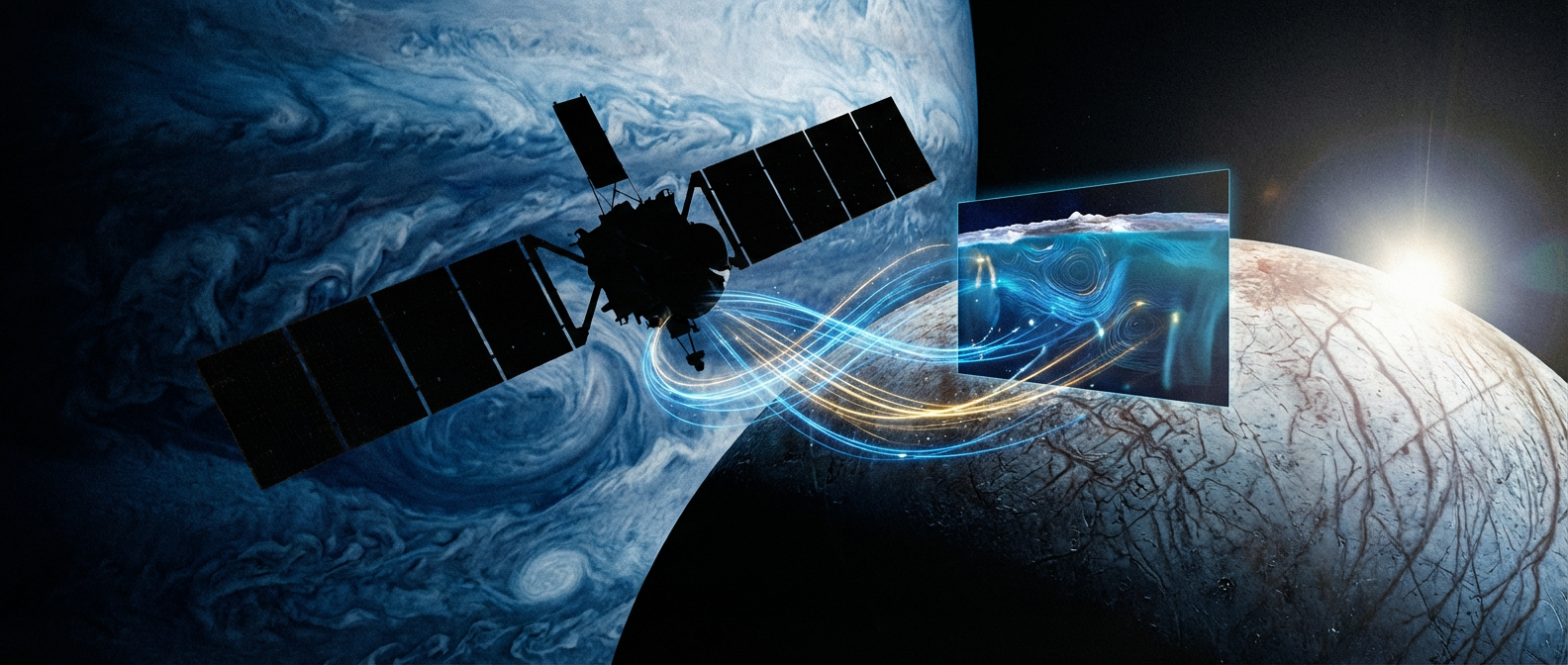
In December 2024, NASA’s Europa Clipper executed its first close approach to Jupiter’s moon Europa, skimming within 25 kilometers of the surface while all nine of its science instruments fired simultaneously. This matters because we had theories. We had models built on decades of orbital imagery and indirect measurements. Then actual data arrived, and—as tends to happen in science—some of our assumptions started coming apart at the seams.
The thing about failed predictions is they’re often more interesting than confirmations. A prediction that nails the target tells you your model probably works. A prediction that misses tells you something about the universe you didn’t know before. Europa Clipper’s first dataset is giving us both, which is why the scientific community is essentially losing its collective mind right now while pretending to remain composed at conference tables.
Every instrument working together during that single pass was deliberate. You can’t get 25 kilometers from an icy moon and waste the opportunity by having your spectrometers sit idle. The spacecraft was designed for this kind of coordinated data capture, pulling in complementary streams that let you build a much richer picture than any single instrument could provide alone.

The Carbon Compounds Plot Twist Nobody Predicted
Here’s where it gets intellectually satisfying in that specific way where you realize your previous model was incomplete. Europa’s subsurface ocean contains roughly twice as much liquid water as every ocean on Earth combined, according to NASA Jet Propulsion Laboratory models. That’s not new information—we’ve known this for years. What is new is what we’re finding dissolved in that water.
The MASPEX mass spectrometer detected complex carbon-bearing compounds in Europa’s plume material during the December flyby. This builds directly on the 2023 James Webb Space Telescope detections of carbon dioxide on Europa’s surface, but the details matter here. MASPEX isn’t just finding carbon—it’s finding it in configurations that suggest chemical processes we need to rethink. Europa Clipper Science Instruments Overview – JPL walks through the technical specifications, but the practical implication is simpler: we’re seeing evidence that Europa’s ocean chemistry might be more complex and potentially more hospitable to interesting chemistry than our baseline models suggested.
The honest part? We thought we understood Europa’s chemistry better than we apparently do. The ocean was supposed to be simpler. Saltier, sure. More geochemically active than we initially modeled, absolutely. But these carbon compounds are whispering something about energy sources and chemical reactions that our current frameworks aren’t fully capturing yet. That’s not a failure of the instruments. That’s a failure of our predictions, which is exactly what good science is supposed to reveal.
Why 49 Flybys Matters More Than One Perfect Dataset
One close pass gets you compelling data. Forty-nine close passes get you a revolution. Europa Clipper is designed to complete 49 flybys of Europa over its four-year primary mission, with the next major sequence starting in 2025. This isn’t redundancy. This is strategy.
Each flyby targets different regions, different altitudes, and different seasonal conditions. You’re building a complete picture instead of a single snapshot. The December pass was the proof of concept—we needed to confirm the spacecraft actually works and that our instruments could function at close range without catastrophic failure. They did. Now the real work begins, and it’s the kind of work where previous data informs the next approach.
This is how planetary science actually operates when it works well. You don’t design a single perfect experiment and stake everything on it. You design a mission architecture that lets you iterate, learn, and adjust your priorities based on what you’re actually seeing. The next flybys will target features that the December data flagged as interesting. You’re having a conversation with the moon across millions of kilometers and months of time, and Europa is gradually revealing what it’s hiding.
The Message In the Machine
The Europa Clipper carries 2.6 million names inscribed on a silicon microchip, along with a poem by Ada Limón, as part of NASA’s “Message in a Bottle” campaign. This sits alongside the actual science instruments, which is a strangely perfect metaphor for how we do this work. Rigorous technical engineering and human meaning-making aren’t opposites. They travel together in the same spacecraft.
The poem reads: “We send this message on the hope that someday, someone among the stars will find it and know that here, on Earth, we existed. We lived. We reached out.” It’s not scientific. It’s not contributing to our understanding of Europa’s subsurface chemistry. And yet it’s carrying the same mass, traveling the same millions of kilometers, and existing in the same mission as the mass spectrometers and magnetometers. That contradiction feels important somehow.
What Comes Next: The Boring and the Explosive
The boring part: we’re now going through months of data processing, calibration, and comparative analysis. Scientists are cross-referencing the MASPEX results with imagery from the spacecraft’s other instruments. They’re modeling what Europa’s plume dynamics mean for our understanding of the subsurface. This work doesn’t make headlines. It’s slow and methodical and absolutely essential.
The explosive part could come anytime over the next few years. Each new flyby dataset could confirm our revised models or shatter them again. Europa could reveal that its ocean is even stranger than we’re currently imagining. The complexity we’re already seeing in the carbon chemistry suggests there are still surprises waiting. For specific updates on mission progress, NASA Europa Clipper Mission Updates keeps you current as discoveries land.
Science works best when we remain genuinely uncertain about what we’ll find. The December data proved that Europa still has plenty of uncertainty built in. That’s not a bug in our models. That’s the entire reason we’re going there.
What would you want to know about Europa if you could ask the data directly? The next forty-eight flybys might actually get you an answer.