The Cosmological Constant Gets Questioned
For nearly three decades, cosmologists have operated under a beautifully simple assumption: dark energy is constant. It doesn’t evolve. It doesn’t change. It just sits there at -1 on the equation-of-state parameter w, pushing the universe apart with unwavering mechanical precision. This is the Lambda-CDM model, the standard framework that emerged in the late 1990s when observations of distant supernovae shocked everyone by revealing that cosmic expansion was accelerating rather than slowing down. It won Nobel Prizes. It resolved tensions. It felt settled.
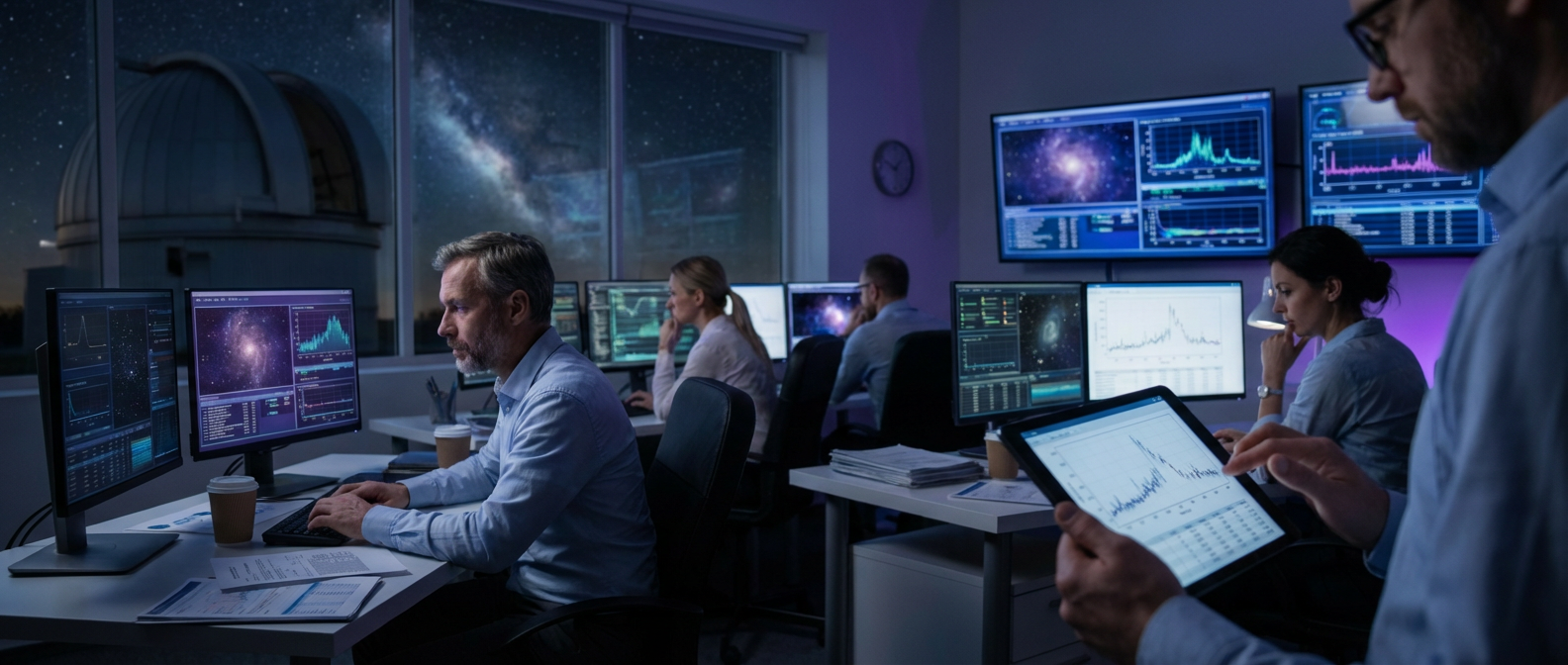
Then the Dark Energy Spectroscopic Instrument released its Year 2 data, and suddenly “settled” became a less comfortable word.
DESI’s new catalog contains spectra from over 14 million galaxies. Fourteen million. That’s more than triple the previous record for a 3D map of the universe. The collaboration, run by Lawrence Berkeley National Laboratory and located at Kitt Peak National Observatory in Arizona, used an array of 5,000 fiber-optic positioners to capture these spectra simultaneously, positioning each fiber with robotic precision across the instrument’s focal plane. The result is the most detailed picture of large-scale cosmic structure we’ve ever assembled.
The Statistical Case Gets Harder to Ignore
Here’s where it gets interesting: when the DESI team analyzed the distribution of these millions of galaxies and compared it to predictions from the Lambda-CDM model, something wasn’t quite fitting the way physicists expected. The data now suggests, at a confidence level approaching 3.9 sigma, that the dark energy equation-of-state parameter w is not equal to -1. Three-point-nine sigma might sound like academic hedging, but in particle physics that’s the threshold where researchers start having actual conversations at conferences instead of polite nods.
What does w not being -1 actually mean? If dark energy is evolving—if its properties are changing across cosmic time rather than remaining perfectly constant—then the entire theoretical framework that’s organized cosmology for 25 years starts wobbling. Not crumbling. Not wrong. But wobbling in ways that matter. Check DESI Official Results and Data Releases to see the actual measurements and their uncertainties laid out.
I talked to colleagues who work in related areas, and the mood is simultaneously excited and exhausted. These are people who have spent careers refining measurements within the Lambda-CDM framework. Finding that framework potentially inadequate is thrilling in an abstract sense and professionally complicated in every practical sense.
The Hubble Tension Whispers in the Background
None of this exists in isolation. The universe has been sending mixed signals about how fast it’s expanding. Local measurements using nearby galaxies and supernovae give roughly 73 kilometers per second per megaparsec. Measurements from the cosmic microwave background, looking back to when the universe was 380,000 years old, give roughly 67 kilometers per second per megaparsec. That six-kilometer difference might sound trivial until you realize it appears in every single measurement and has been consistent across multiple independent studies. This is the Hubble Tension, and it has been gnawing at cosmologists for years.
The uncomfortable possibility is that these measurements aren’t contradictory because of systematic errors but because they’re actually right and the universe’s expansion rate genuinely changed over cosmic history in a way that current models don’t capture. If dark energy is dynamically evolving rather than constant, that evolution could potentially explain why the expansion rate looked different 13 billion years ago compared to today. It’s not a clean fix. It’s nowhere near proven. But it’s the kind of lead that keeps people in their offices past midnight, running simulations.
For a deeper look at what the DESI collaboration actually found and what they think it means, Lawrence Berkeley Lab DESI Year 2 Analysis provides thoughtful context from the scientists running the instrument.
Why This Matters More Than You’d Think
Science works through progressive refinement. The Lambda-CDM model wasn’t handed down from on high; it emerged from observations and has been tested repeatedly. Finding that one of its core assumptions might need revision isn’t a failure of the model or a failure of science. It’s exactly what’s supposed to happen when you build better instruments and collect better data.
What makes the DESI results genuinely significant isn’t that they prove dark energy is evolving. It’s that they’ve reached the statistical threshold where that possibility can’t be dismissed or explained away by measurement uncertainty. The error bars are tightening. The picture is coming into focus. And the picture looks different than we expected.
The cosmological community is now sitting in productive uncertainty. DESI will continue collecting data. Other experiments are running in parallel. Theorists are already working out what dynamical dark energy models would look like and what predictions they’d make. Eventually the picture will either sharpen into a new consensus or resolve back into confidence in the old one, supported by even more detailed evidence. Both outcomes advance the field.
The Sleepless Nights Are Just Getting Started
The best part of working in cosmology right now is that something genuinely interesting might be happening. We’re not tightening bolts on an obviously complete theory. We’re potentially watching cracks form in the foundation, and yes, that’s unsettling, but it’s also exactly why people chose this work. The universe isn’t cooperating with our assumptions, and that’s when the real work begins.
If you want to follow along as this unfolds, the data is public. The DESI collaboration publishes everything. You don’t need specialized credentials to download the catalogs and poke around, or to follow the theoretical papers that will inevitably accumulate. Some of the most interesting challenges in cosmology right now live at the intersection of precise observation and theoretical creativity, and that intersection is wide open. What aspects of cosmic evolution are you most curious about, or what gaps in this picture do you think matter most?