The Threshold That Changes Everything
For decades, quantum computing researchers have been chasing a specific mirage. Add more qubits to your quantum system, and the error rates climb. Add more error correction code, and you introduce more places for errors to hide. It’s a cruel trap. You need redundancy to catch mistakes, but that redundancy creates vulnerability. The breakthrough Google announced in December with their Willow chip isn’t flashy in the way that matters most to headlines, but it is genuinely revolutionary: they crossed the error correction threshold. Below-threshold quantum error correction means that adding more qubits to their system actively reduced errors instead of multiplying them. This isn’t incremental progress. This is the moment the field stops asking “if” and starts asking “when.”
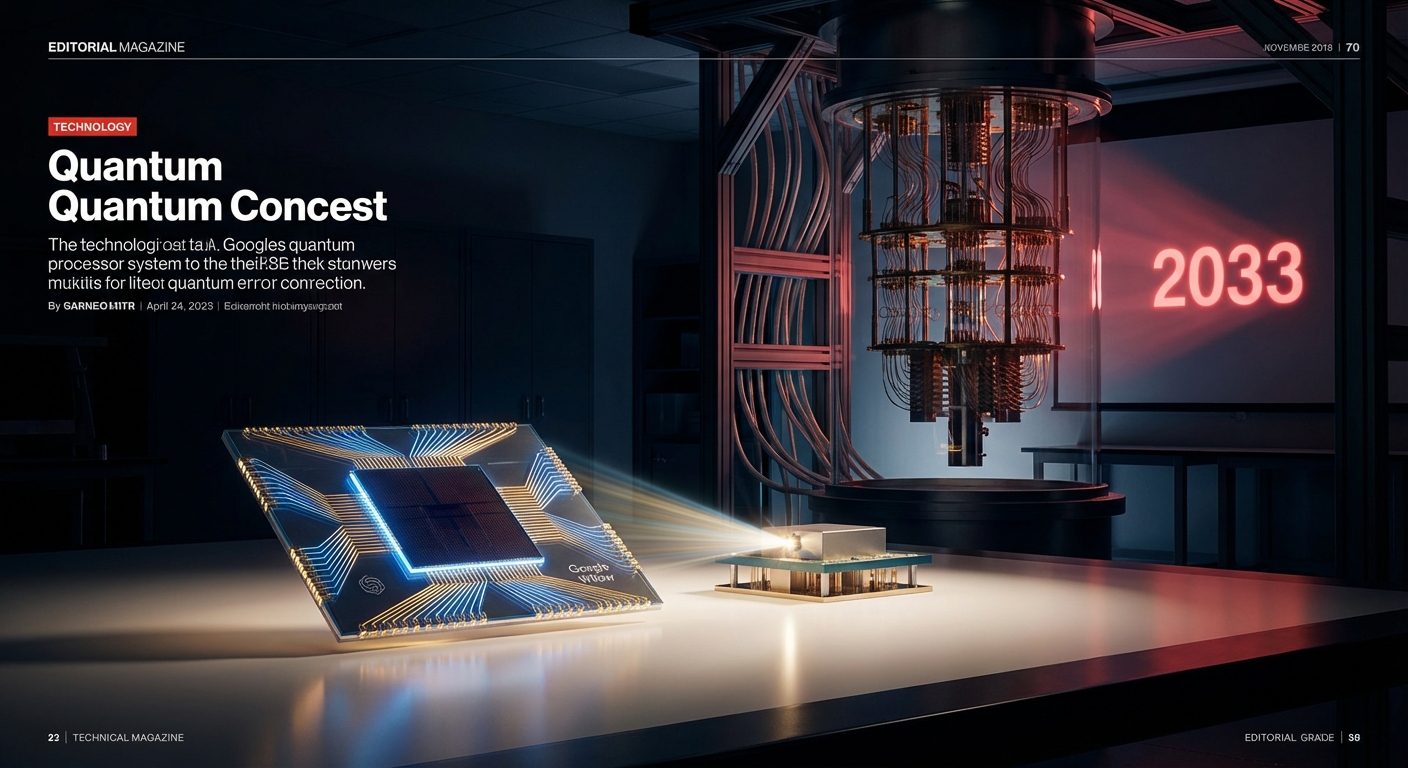
Willow achieved this on 105 physical qubits, using Google’s surface code architecture to create logical qubits, the error-corrected versions that matter for actual computation. The performance matched theoretical predictions almost exactly: roughly a twofold improvement in logical qubit error rates for each doubling of code distance. That consistency with theory is what made physicists sit up and pay attention. Theory had suggested this should work. Watching it actually work in hardware is different.
What Willow Actually Did, and Why the Numbers Matter
Google’s benchmark result, completing a random circuit sampling calculation in under five minutes that would take classical supercomputers 10 septillion years, grabbed headlines for obvious reasons. That number is almost impossible to contextualize. But here’s why it matters beyond the spectacle. Random circuit sampling is deliberately designed to be hard for classical computers but comparatively easy for quantum computers to solve. It’s not a business problem or a scientific simulation. It’s a test. What it demonstrates is that Willow can do quantum operations faster and more reliably than current alternatives at scale. The real story, though, is the error correction.
The Google Willow Quantum Chip – Nature Paper shows the detailed architecture and performance metrics. What jumps out to anyone reading carefully is that this isn’t one lab’s isolated success. The results align with decades of theoretical work in quantum error correction. The surface code model, developed largely by the quantum computing community over the past 20 years, predicted exactly this kind of scaling. Willow proved those predictions work in the real world, with real hardware, real noise, and real engineering constraints.
The Competition and the Timeline Collision
IBM’s quantum roadmap targets 100,000 physical qubits by 2033 to achieve fault-tolerant quantum computing. That’s a deliberate, methodical engineering plan. It’s also now potentially outdated. Willow suggests that the error correction milestone enabling practical quantum advantage might arrive significantly earlier than that timeline. IBM isn’t wrong about the scale they’re targeting, but Google’s threshold breakthrough changes the calculus for what scale is actually necessary and when it might be achievable.
What’s interesting here isn’t competition in a corporate sense. It’s that different teams were solving the same fundamental problem using different approaches. IBM’s roadmap emphasized qubit count. Google emphasized error correction efficiency. Both paths lead toward the same destination, but one might get there first. That’s exactly how science should work. Multiple groups testing different hypotheses, publishing results, and letting the evidence speak.
Why NIST Got Nervous About Your Passwords
The timing is conspicuous. NIST finalized its first three post-quantum cryptography standards in August 2024, just months before Willow’s announcement. That wasn’t coincidence. Governments and security experts started treating quantum computers breaking RSA-2048 encryption as a credible near-term threat rather than a theoretical concern. Not because quantum computers can do it yet, but because the timeline shifted. The capability moved from “probably not in our lifetime” to “maybe in the next decade or two, and we need to start protecting data now.”
This is where the human element gets interesting. Cryptographers aren’t usually alarmists. They’re cautious by profession. The fact that NIST Post-Quantum Cryptography Standards happened when they did reflects a specific shift in how seriously institutions were taking the quantum timeline. Willow didn’t cause that shift, but it confirms the urgency was warranted.
What Comes Next Matters More Than What Just Happened
Threshold crossings in physics are inflection points. They’re moments when previously impossible things become merely difficult. No one should expect quantum computers to solve optimization problems next year. The engineering challenges remaining are still enormous. But the fundamental impossibility has been removed from the conversation. You can now talk about scaling quantum error correction as an engineering problem with a known solution path, not as a physics problem that might not have one.
What happens now depends on whether other groups can replicate this result independently and whether the efficiency Willow demonstrated can be sustained or improved. That’s the real test. One breakthrough is elegant. Reproducibility is something else entirely. The quantum computing field has always been generous about sharing findings, probably because everyone understands that the destination is worth more than individual credit. If other groups confirm that threshold crossing is a repeatable phenomenon rather than a one-off success, the timeline for practical quantum computing compresses dramatically.
Where are you following the quantum computing story? Have you dug into the Nature paper, or do you have other sources tracking this space? The physics is only half the story now. The engineering and policy responses to these breakthroughs matter just as much. I’m genuinely curious what aspects of this transition feel most significant from where you’re sitting.