The December Announcement That Broke the Internet
Google dropped a bomb in December 2024 when they announced Willow, a quantum chip that completed a specific benchmark calculation in under five minutes. The number they attached to this achievement was impossible to ignore: a classical supercomputer would need roughly 10 septillion years to solve the same problem. That’s a trillion times the age of the universe. The press releases flew. The stock prices twitched. Everyone suddenly had opinions about quantum supremacy.
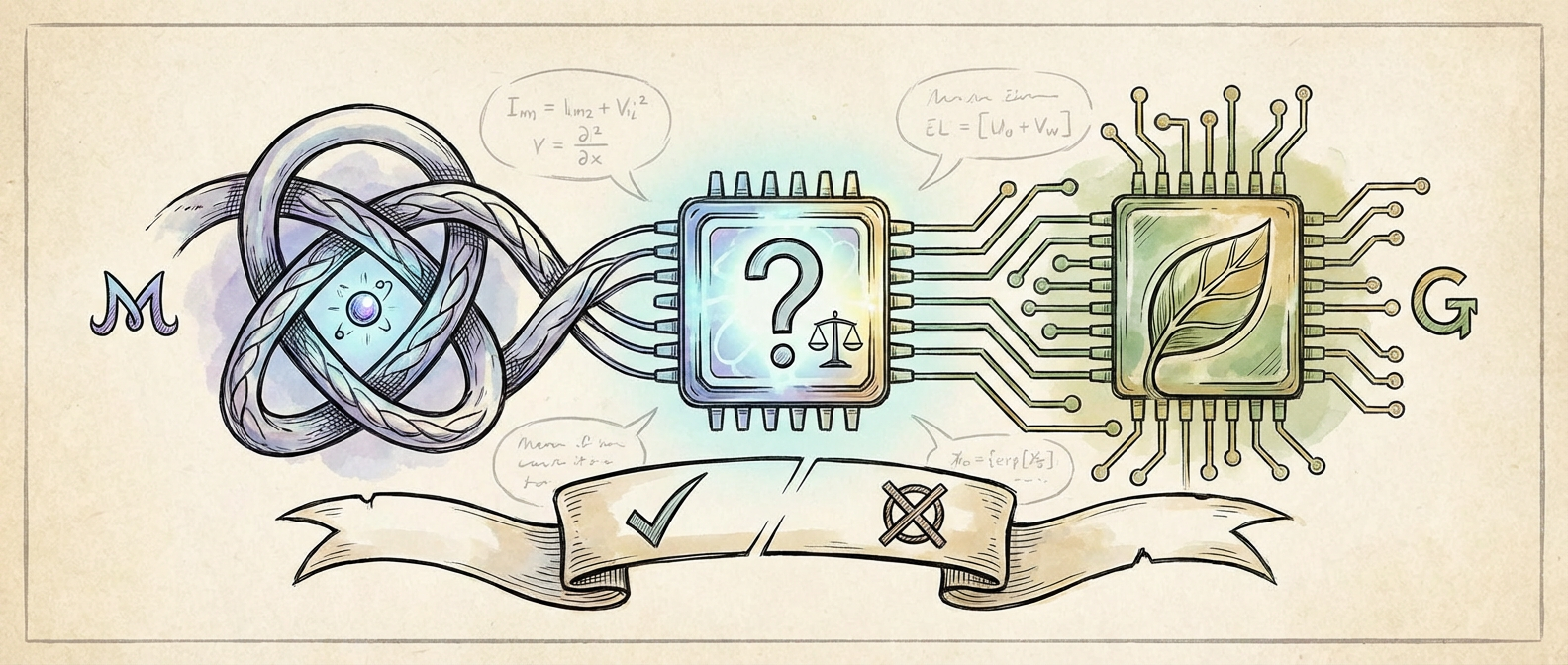
Here’s the thing nobody wanted to lead with: the problem Willow solved has no real-world application. It was a benchmark test, designed specifically to showcase quantum advantage. It’s like bragging that your sports car can hit 200 miles per hour on a closed track while your daily driver gets you to work faster because the speedway is in the opposite direction. Impressive physics. Useless engineering.
But the headline was only half the story. The actual achievement buried deeper in the research, published in Nature with 50 co-authors, was something else entirely. Willow demonstrated below-threshold error correction. Adding more qubits to the system actually reduced error rates instead of compounding them. That’s the real breakthrough. That’s the door opening to something functional.
Microsoft’s Topological Gamble
Then February 2025 arrived, and Microsoft unveiled Majorana 1. Different approach. Different architecture. Different promises. Where Google and IBM built their quantum systems on superconducting qubits that need elaborate cooling systems and constant error correction, Microsoft opted for topological qubits. The claim: inherent error resistance baked into the physics itself.
Microsoft Azure Quantum Majorana 1 is a fundamental bet on topology as the answer to quantum fragility. The math is elegant. Topological qubits encode information in the properties of exotic quasiparticles that are theoretically protected from certain types of environmental interference by the laws of topology itself. If it works at scale, you get stability without needing to throw thousands of physical qubits at every logical qubit you want to create.
My hesitation comes from a century of quantum physics teaching us that elegant in theory isn’t the same as reproducible in practice. Microsoft has been working on this approach for years. Majorana 1 is their proof of concept. But proof of concept for a startup would be headline news. For Microsoft, it’s a checkpoint on a very long road.
The Error Problem That Won’t Go Away
Both chips tackled different versions of the same problem haunting quantum computing: error rates. Current systems are wildly fragile. IBM’s quantum roadmap, aggressive and publicly committed, targets 100,000 physical qubits by 2033. That’s real. But here’s what gets whispered in quantum labs: to create a single reliable logical qubit right now, you need approximately 1,000 physical qubits as error-correction overhead. So IBM is planning to build a system where 99 percent of the hardware exists just to keep the other 1 percent from falling apart.
Willow’s below-threshold error correction changes that equation. It suggests the ratio can improve. More qubits could mean fewer errors, not more. That’s the physics flipping in the right direction. Majorana 1’s topological approach suggests a different path: fewer physical qubits needed because the errors are harder to introduce in the first place.
These aren’t competing claims about who’s winning. They’re different experiments testing different hypotheses about how to solve the same engineering crisis. The quantum field has room for both approaches to fail, succeed, or partially deliver. Right now, nobody knows which path leads somewhere useful.
What the Science Actually Says About Timelines
University of Waterloo researchers published a comprehensive review in Science in early 2025 that landed like a cold shower on the hype cycle. The paper was direct: current quantum supremacy benchmarks solve problems with zero practical applications. The calculations Google and Microsoft are showcasing are demonstrations of quantum advantage within a narrow definition. They prove the technology can do something classical computers find hard. They don’t prove the technology can do something useful.
The cryptography timeline everyone loves to cite? Breaking RSA encryption with quantum computers? The Waterloo review cautioned hard against that narrative. Not impossible. Just not imminent. Not in 2025. Not in 2030. The error correction problem sits between us and that capability like a mountain that’s barely been surveyed.
Google Quantum AI Willow Announcement claims quantum advantage. That’s technically accurate. The Waterloo paper doesn’t dispute that. It disputes the distance from advantage to application. There’s a difference between proving you can build something and proving it solves a problem anybody cares about solving.
Where This Actually Goes From Here
The next five years matter enormously. Willow’s error correction scaling needs to hold. Majorana 1 needs to prove it can scale beyond proof-of-concept. IBM needs to deliver on the roadmap. The quantum field is exactly where it should be: multiple approaches being tested simultaneously by organizations with the resources to fund real failure. That’s how you de-risk emerging technology.
What won’t happen: cryptography breaking in 2026. What might happen: demonstrations that topological qubits can match superconducting qubit performance with lower overhead. What probably will happen: another press release in six months claiming another breakthrough, written in language that makes it sound like quantum computers are coming to your phone next year.
The science is genuinely exciting. The progress is real. The timeline skepticism is warranted. If you’re waiting for quantum computers to matter in your life, keep waiting. If you’re more interested in how we build fundamentally new types of computing hardware, watching this field right now is watching the real thing unfold. What part of this puzzle interests you most?